
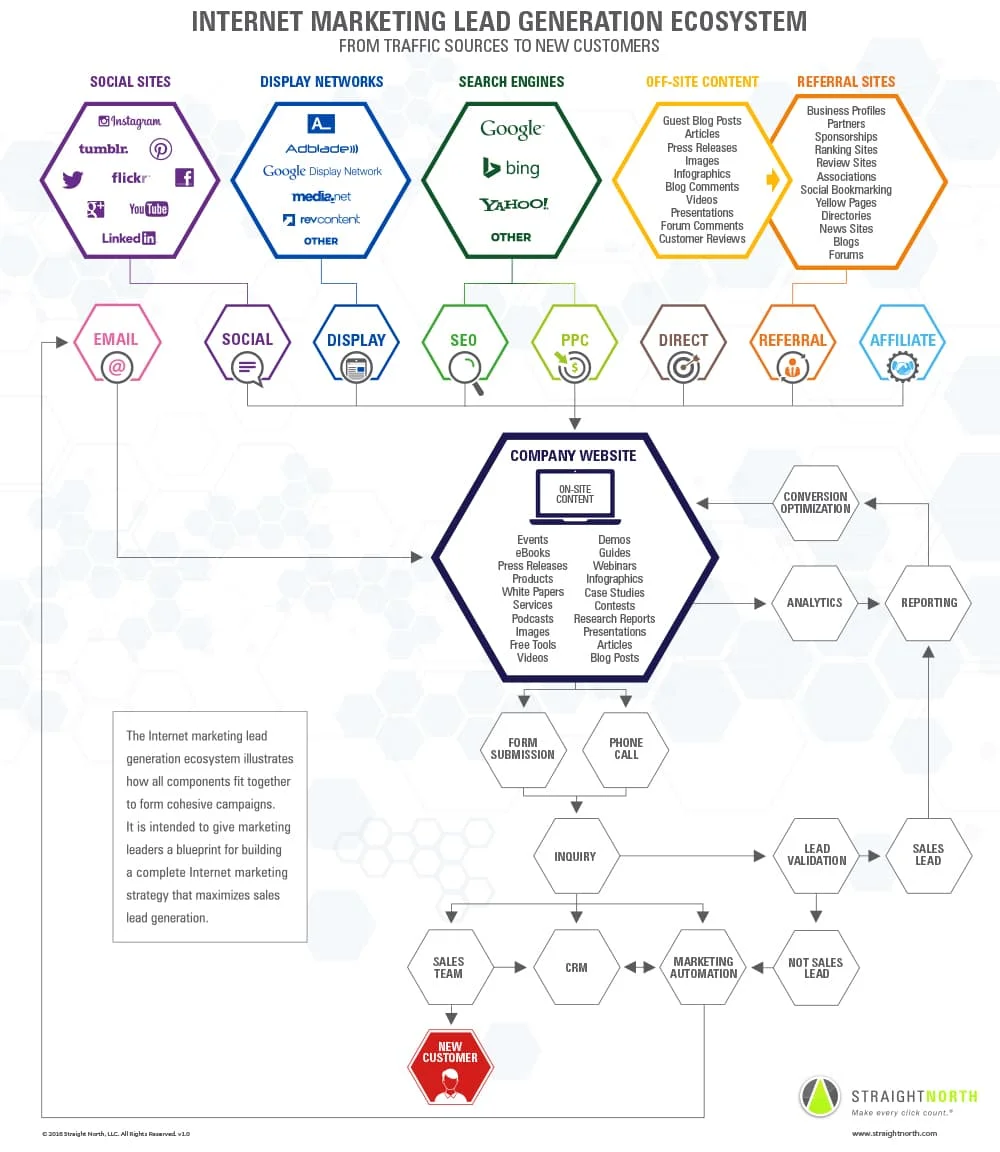
Internet marketers are accustomed to thinking about lead generation campaigns as a basket of elements — SEO, conversion optimization, analytics, etc. While this is certainly true, having a handle on all of the necessary elements is only one challenge. Another challenge, and perhaps a more important one, is to understand how all of these elements are connected. If SEO, conversion optimization, analytics, etc., all are conducted in a vacuum, then they will lose some or all of their effectiveness and the entire campaign will sag or collapse.
With this in mind, Straight North created the “Internet Marketing Lead Generation Ecosystem” infographic. It helps online marketers visualize not only the entire landscape of lead generation campaigns, but also — and more critically — how these various elements are connected and affect one another. By properly connecting all of the pieces, lead generation campaigns improve faster and over time can fill the sales lead pipeline to the point of bursting. In this article, we’ll take a closer look at areas of the lead generation ecosystem that frequently lack connectivity.
Connecting Email to the Website
Email marketing campaigns continue to be effective and popular. However, email marketers sometimes miss lead generation opportunities by failing to link emails to the company website in an effective manner.
For instance, rather than use email for merely “customer touches” with no clear conversion path, emails should highlight products, services, special buying opportunities, etc., with links to landing pages on the website designed to cement the conversion. It makes more sense to link to the website than attempting to make the email itself a landing page:
- An email designed as a landing page could strike subscribers as being spam.
- An email designed as a landing page could wind up being too long to be effective, especially for mobile viewing.
Perfunctory links to the website (e.g., a link to the home page embedded in the company logo in the email template) garner few click-throughs, and even when click-throughs occur, the destination page is not one that necessarily brings the website visitor into any sort of conversion funnel. In contrast, a lead generation strategy linking email content to a website landing page has terrific potential.
Connecting Phone Calls to the Tracking Process
Sales leads that flow through the company website are either form submissions or phone calls. Most companies with structured lead generation campaigns track form submissions; with Google Analytics and most other website analytics packages, form tracking is a pretty standard function.
Phone tracking, however, is not something Google Analytics and similar packages provide. In order to determine which Internet marketing source produced the phone call, a company must install phone tracking, something that requires selecting the right tracking service provider and applying a bit of specialized web development work to the website.
Tracking phone calls is extremely important, in that phone leads are quite often better quality leads than form submissions. If a user takes the time to call, he or she may have a complicated or urgent need. These days, very few people want to talk to a salesperson if they have only a casual interest!
Proper phone lead tracking must be granular; effective phone tracking systems provide each user with a unique phone number, enabling marketers to identify with certainty which campaign (SEO, PPC, downloaded PDF, etc.) produced the conversion. Anything less than this leaves areas of doubt that hamstring the marketer’s ability to evaluate campaign performance. Gray areas in campaign performance set the stage for errors in terms of which campaigns to emphasize and de-emphasize.
Connecting Reporting to Conversion Optimization
Conversion optimization involves testing website elements to bring more users into the conversion funnel and increase the percentage of visitors who submit a form or phone in with an inquiry. The big issues for conversion optimization are always which elements to test, and how to test them.
There are basically two ways these issues can be resolved: One is for marketers or their superiors to whimsically decide which elements to test and how to test them. The other way is for marketers to rely on solid reporting data to drive testing decisions.
While marketers would naturally endorse the second approach, it is surprising how many companies actually fall into the first one of arbitrarily making testing decisions. For example, the owner of a small business may get a brilliant (or seemingly brilliant) idea for a promotion while eating breakfast, and insist the marketer rewrite the PPC ad that same morning.
Arbitrary testing occurs for reasons other than this, too. Sometimes it is the result of poor data or no data. For instance, if the marketer does not have sales lead data that has been validated (see the lower right section of the infographic), he or she will not know which campaigns generated sales leads as opposed to inquiries. This is a very important distinction! Many phone calls and form submissions acquired through Internet marketing campaigns are something other than leads — instead they are things such as spam, customer service calls, personal phone calls, auto dials and sales solicitations.
Our agency data, based on nearly two years of lead validation, consistently shows that as many as half of all website inquiries are not leads.
(Please pause for a few seconds to ponder that.)
If marketers are aware they have an internal reporting system that lacks validation, they will not base testing decisions on inquiry data in their reports because a high number of inquiries does not necessarily mean a high number of leads. In this situation, the marketer will probably be better off basing testing on his or her own instincts and experience.
If, on the other hand, marketers are not aware their system lacks validation, they will do something far worse than use their instincts — they will base testing on faulty data and undermine their efforts and their lead production.
Not being aware of the need for lead validation is a real issue: Many companies fail to see this distinction because standard reporting tools usually track form submissions without making any qualitative distinction among them. Over time, companies tend to interpret all conversions as leads. However, this distinction cannot be glossed over, as it is especially harmful in terms of conversion optimization. Consider:
- If PDF A generated 200 inquiries and PDF B generated 100, the marketer will put more emphasis on PDF A.
- However, if validation is used and the marketer sees PDF A generated 25 leads and PDF B generated 50 leads, he or she will put more emphasis on PDF B.
Thus with validation, the marketer puts the emphasis where it should be, whereas the marketer without validation puts emphasis exactly where it should not be. Multiply this situation times the many hundreds or thousands of conversion optimization decisions made over the course of a campaign, and you can quickly see how devastating bad reporting data is to lead generation.
Connecting Non-Leads to Marketing Automation
A final point to touch on has to do with the many non-leads we were discussing in the section above. Some companies send non-leads to the garbage bin at some point, often when the sales reps realize they are chasing dead ends.
Non-leads have value, however, and should be retained in the marketing automation system for future use. Consider:
- An inquiry from someone trying to sell you something is from a person in a related business. This means the person could be a source of referrals.
- An inquiry from a customer with a product/service support question could be an entirely new contact within the account — perhaps a person with greater buying authority or influence than your current contact has.
- An inquiry that doesn’t fit your offering comes from a C-level executive at a large firm, but he or she could be a tremendous person to cultivate for future sales opportunities or referrals.
For email marketing in particular, building a solid house list of contacts is arguably the most critical component of success. Many companies can rapidly boost the quantity and quality of their house lists simply by paying serious attention to inquiries that don’t have an obvious or immediate payoff.
This illustrates why it is always important for online marketers to think about the short term and the long term. For lead generation campaigns, it is very tempting to concentrate on the short term — success is measured by hot leads generated today. This is certainly what the boss wants to see!
But filling a lead pipeline requires both short-term and long-term successes. The fact is, most website visitors or Internet users exposed to your marketing campaigns are not in the market for your product or service right now. This means that even with a high number of inquiries, it will take time to close the sale or even set up the sale.
Are You Well Connected?
If your Internet marketing campaigns resemble the infographic, especially at the connectivity points, you are in great shape. However, if you have pieces of your campaign that are dangling, the infographic may help you visualize the necessary fix. Internet marketing is getting more complicated by the day, with new technologies and best practices coming at us at an increasingly rapid pace. Having a solid lead generation process is the only way to stay on track.
